

Sarah Hussain
B.Eng., MSc., FHEA
Research Impact
Sarah Hussain presents at STEM for Britain in Parliament
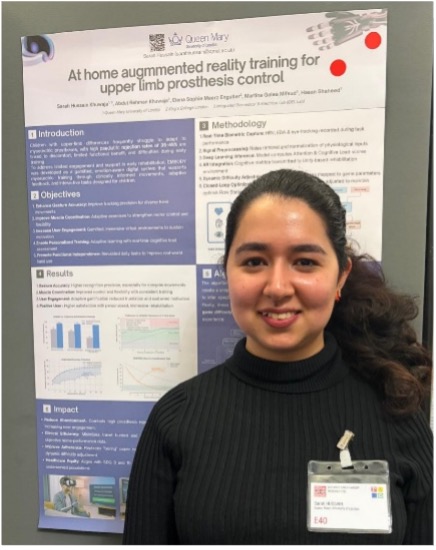
Sarah Hussain from the School of Engineering and Materials Science at Queen Mary University of London was selected as a finalist at this year's STEM for Britain competition, held at the House of Commons on Tuesday 17 March 2026. The event is one of the UK's most competitive showcases for early-career researchers, bringing together some of the country's most promising researchers to present their work to Members of Parliament and leading scientists. Organised by the Parliamentary and Scientific Committee, the exhibition has been running since 1997.
Sarah presented her project, "At Home Augmented Reality Training for Upper Limb Prosthesis Control", which explores a gamified, emotion-aware augmented reality system to support children learning to use myoelectric prostheses. By combining real-time biometric data with adaptive feedback, the project aims to make rehabilitation more engaging, accessible, and effective in home environments.
Queen Mary research presented at IEEE MetroXRAINE conference
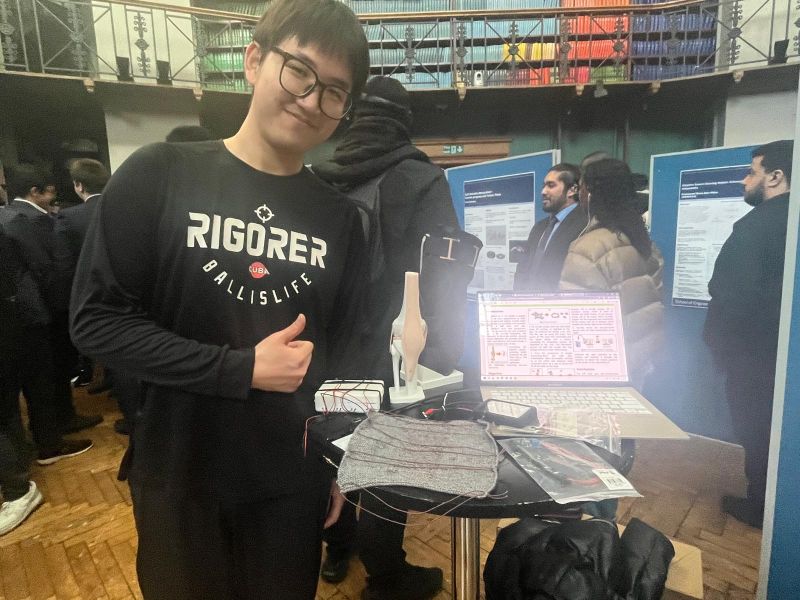
Research from Queen Mary University's School of Engineering and Materials Science was presented at the 2025 IEEE International Conference on Metrology for eXtended Reality, Artificial Intelligence and Neural Engineering (MetroXRAINE).
The paper, "KneeFlex: A Soft Wearable Knee Joint Tele-rehabilitation Robot", led by MSc student Tongyan Zhang, introduces a soft, wearable robotic system designed to support home-based rehabilitation for patients recovering from procedures such as total knee replacement. The device combines breathable, washable piezoelectric textile sensors with soft TPU airbag actuators to deliver joint angle tracking and pneumatic support, aiming to make unsupervised, at-home rehabilitation more comfortable, reliable, and effective.
Experimental testing showed that the piezoelectric textile sensor maintained stable performance across dry, soaked, and post-wash conditions, while the airbag actuators reliably generated cyclic support forces during repeated use. These findings highlight the system's potential for long-term, real-world wearable rehabilitation use.
The paper was co-authored by Tongyan Zhang, Lian Zhou (Tongji University), and Sarah Hussain (SEMS, Queen Mary). Sarah presented the work on Tongyan's behalf at the conference.
Read the full paper: https://ieeexplore.ieee.org/abstract/document/11340512
MSc Student Presents QMUL Research at CLAWAR 2025
.jpg)
Shayan Usman, an MSc student at Queen Mary University of London, presented the paper "Design and Integration of a 15-DOF Myoelectric Prosthetic Hand with Tendon-Driven Actuation and Force Feedback Control" at the CLAWAR 2025 International Conference on Climbing and Walking Robots and the Support Technologies for Mobile Machines, held in Shenzhen, China from 5 to 7 September 2025.
Supervised by Dr Hasan Shaheed and Sarah Hussain, Shayan showcased the design and integration of a 15-degree-of-freedom myoelectric prosthetic hand using tendon-driven actuation and force feedback control to improve dexterity and functional performance. An extended version of the paper will be submitted to the CLAWAR Journal for publication.
New Project Explores Soft Robotics for Next-Generation Prosthetic Sockets

Dr Thilina Lalitharatne (Principal Investigator) and Sarah Hussain (Co-Investigator) were awarded a short-term EPSRC-funded Bionic+ Research and PPI grant to investigate soft robotics-inspired approaches for the design of upper-limb prosthetic sockets. The award followed a research sandpit organised by the University of Warwick.
The project focuses on developing next-generation prosthetic sockets that improve comfort, adaptability, and user experience through soft robotic technologies. By involving prosthetic users, clinicians, and other stakeholders throughout the design process, the team aims to ensure that future socket designs are driven by clinical needs and lived experience.