

Dr Yiwei Sun
BSc, PhD
News
March 2026 | ||
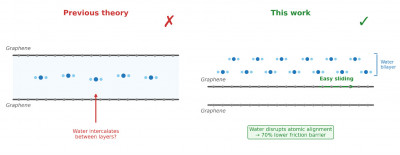 Why does graphite need water to be a lubricant? The answer isn't what we thought18 March 2026New research overturns the long-held theory that water slips between graphene layers to lubricate graphite — instead, it sits on the surface and disrupts the perfect atomic alignment that causes friction. In the 1940s, the US Air Force had a problem. The graphite brushes in electrical motors on high-altitude aircraft … [more] | ||
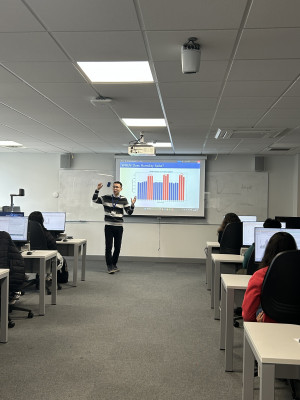 Year 12 students solve real engineering mysteries using AI16 March 2026Students become 'Materials Detectives' for a day Twenty-six Year 12 students from schools across London and South East England visited Queen Mary's Mile End campus on 28th February for an interactive workshop that challenged them to solve two data mysteries — and every team cracked both cases. In the first … [more] | ||
December 2025 | ||
 New study offers data-driven approach to identify struggling students early in the term24 December 2025A new study published in Computer Applications in Engineering Education by Dr Yiwei Sun from the School of Engineering and Materials Science demonstrates how engineering educators can use statistical analysis of routine assessment data to identify at-risk students and pinpoint which topics need more teaching time. Three groups of students, … [more] | ||
April 2021 | ||
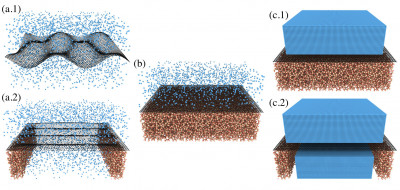 What we know – and don’t know – about the mechanical and thermal properties of graphene21 April 2021In this Featured Article published in Applied Physics Reviews,Prof. David Dunstan from the School of Physics and Astronomy, Prof. Sir Colin Humphreys, Dr. Dimitrios Papageorgiou and Dr. Yiwei Sun from the School of Engineering and Materials Science, review what we know and don't know about the mechanical and … [more] | ||
April 2020 | ||
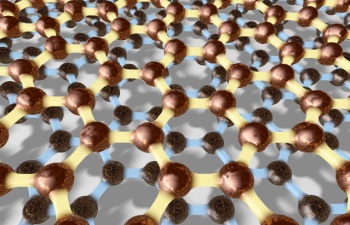 New study reveals unexpected softness of bilayer graphene30 April 2020In the study, published in the journal Physical Review B, the researchers showed that bilayer graphene, consisting of two layers of graphene, was noticeably softer than both two-dimensional (2D) graphene and three-dimensional (3D) graphite along the stacking direction. This surprising result differs from previous research which showed that 2D graphene, … [more] | ||
September 2019 | ||
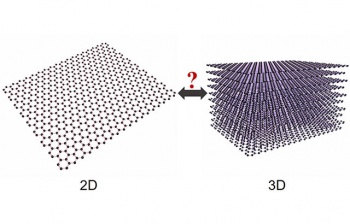 Graphene is 3D as well as 2D25 September 2019Graphene is actually a 3D material as well as a 2D material, according to a new study from Queen Mary University of London. Realising that it is a 3D material is important for understanding its mechanical properties and for developing novel graphene-based devices. Often hailed as a ‘wonder material’, graphene … [more] | ||
January 2019 | ||
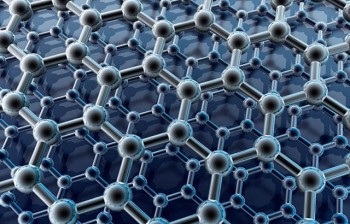 Properties of ‘wonder material’ graphene change in humid conditions21 January 2019Graphene exhibits very different properties in humid conditions, according to researchers from Queen Mary University of London. The ‘wonder material’, which is made from carbon and was discovered in 2004, is hailed for many of its extraordinary characteristics including being stronger than steel, more conductive than copper, light, flexible and transparent. … [more] | ||