

Farnborough Airshow
Following a visit to Farnborough Airshow, Placements Officer Helen ran a competition for student testimonials. Here are our top three winners.
1. George 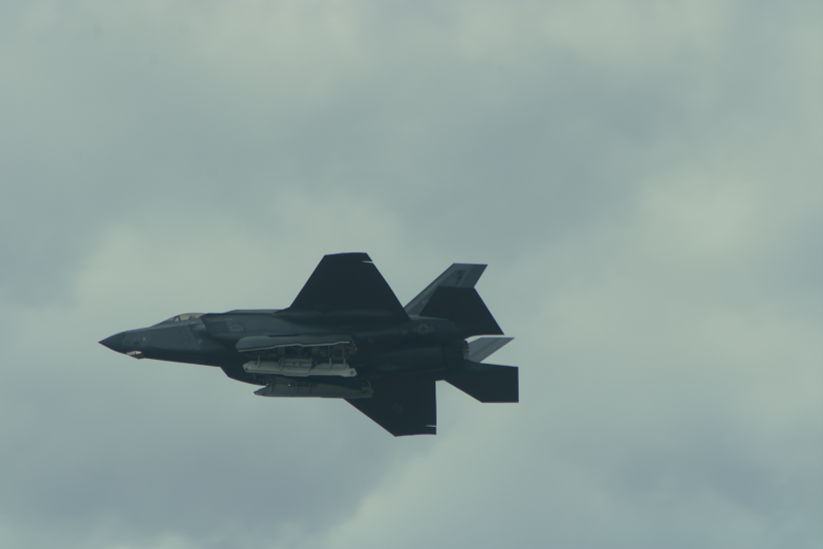
I have spent most of the last two years learning how to make things move precisely. Motors, joints, control loops, error measured in millimetres. Farnborough was the first time I stood in front of engineering operating at a completely different order of magnitude, and I don't think I stopped smiling all day.
The F-35
You hear it before you see it. That's the part nobody quite prepares you for - the sound arrives as something physical, and the whole crowd turns in the same direction at the same moment.
What got me wasn't the speed, it was the control. Watching it hold attitudes that clearly aren't naturally stable, with a flight control system quietly doing an enormous amount of work in the background, was the closest I've come to seeing my own coursework running at full scale. I spend my time tuning controllers to keep a robot arm within a centimetre of a target. Same problem, several thousand times louder.
The Eurofighter Typhoon
If the F-35 was impressive, the Typhoon was fun. Tighter and more theatrical - the kind of display where the crowd audibly reacts on the run-in. There's something brilliant about standing in a field with thousands of people who have all, briefly, agreed that this is the most interesting thing happening anywhere.
On the ground
Wandering the rest of the static displays, what struck me was the overlap across industries: aerodynamics, composites, thermal management, control systems, all showing up in slightly different bodywork depending on where you look. I spent an embarrassingly long time looking at surface finish on things I will never own.
The displays were the spectacle, but the conversations were the point. Talking to engineers and early-careers teams gave me a much clearer picture of what the industry values and how much of the work sits in areas I'm already building towards; autonomy, control, and the unglamorous business of making complex systems behave.
Came home tired, slightly deaf, and considerably more certain about what I want to work on.
2. Mohammed 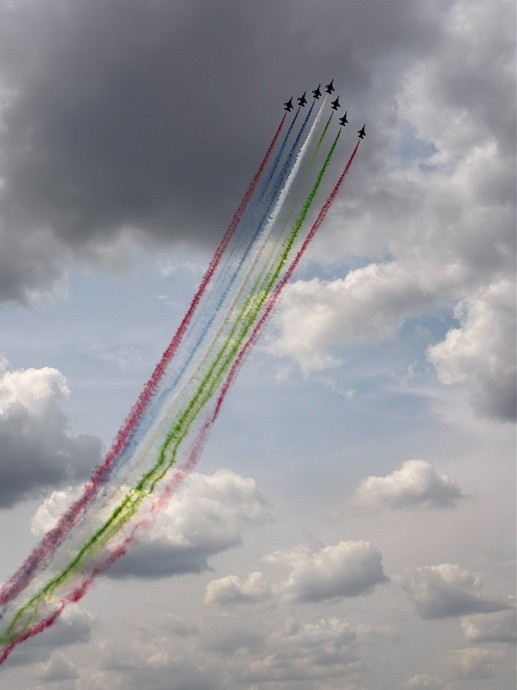
I spent Friday at the Farnborough International Airshow, and I left with a notebook rather than just a camera roll.
My favourite display was Fursan Al Emarat. The UAE National Aerobatics Team made its Farnborough debut with seven Hongdu L-15s, one for each emirate, in black and gold with smoke trails in the national colours. They only converted from the MB-339 in 2025, and re-validating a seven-ship routine on a new type is a serious engineering and training achievement, not just a flying one. When seven aircraft break with that spacing, you are watching thousands of hours of preparation.
The USAF F-35A Lightning II Demonstration Team gave its only public European display of the year. What struck me was not the noise but the low-speed handling: the aircraft holding a high angle of attack, nose well above its flight path, apparently untroubled. Control authority at that end of the envelope is where flight dynamics stops being coursework.
The Airbus A350-1000 flew daily, and watching a widebody rotate steeply with its wings visibly flexing teaches you more about aeroelasticity than any lecture slide.
On the static line, a Georgia Air National Guard C-130J sat on four Rolls-Royce AE 2100 turboprops driving six-bladed composite propellers. My final year dissertation was on low-noise propeller design, so I spent an embarrassing amount of time studying blade sweep and tip geometry while everyone else queued for the cargo ramp.
That turned out to be the thread of the day. The A350 flies on Trent XWB-97s, the most powerful engines Rolls-Royce has put into service. Later, a Supermarine Spitfire PR Mk XIX crossed the crowd line on a Griffon. In one afternoon, the same name covered a 1945 reconnaissance fighter and a 2026 airliner.
In September I start as a graduate engineer at Rolls-Royce. Watching aircraft fly on engines built by a company I am about to join made the next chapter feel considerably less abstract.
Farnborough did not just showcase the industry. It made me impatient to get into it.
3. Hamna 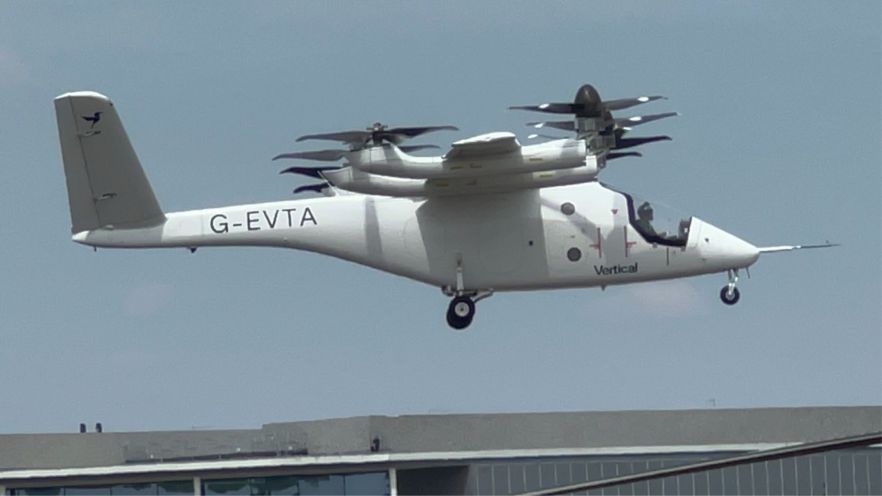
Last Friday, I attended the Farnborough International Airshow with my university, Queen Mary University of London! The live flying display was amazing, especially seeing the aerospace concepts I have studied over the last few years brought to life.
The airshow kicked off with the British Army Red Devils parachute team. Witnessing the parachutists steer through the air under massive aerodynamic drag was beautiful. The ultimate highlight was watching one paratrooper trail a huge Union Flag weighing 90kg in total (ballast included). The immense coordination required to toggle those steering lines and maintain perfect speed control while fighting that drag is phenomenal.
Next came the raw, ground-shaking power of the Italian Air Force Eurofighter Typhoon. Its vertical climbs literally shook the air, but my absolute favourite part was watching it cruise entirely upside down. The presenter beautifully explained the flight physics keeping it stable, showing how symmetrical wing profiles allow the control surfaces to maintain total authority without stalling or losing altitude.
We then saw a total shift in scale with the iconic Airbus A350-1000, proving how sleek a massive wide-body aircraft can be during tight banks. Afterwards, we got a literal glimpse into the future with the Vertical Aerospace eVTOL—a real electric aircraft smoothly switching its control systems from helicopter mode to wingborne forward flight. It is a complete game-changer for urban traffic congestion!
Between the jaw-dropping flying display and the fascinating technical commentary by the presenters, it was an unforgettable experience. Massive thanks to Helen Green for organising such an incredible trip.