

Anika: from Queen Mary to CERN 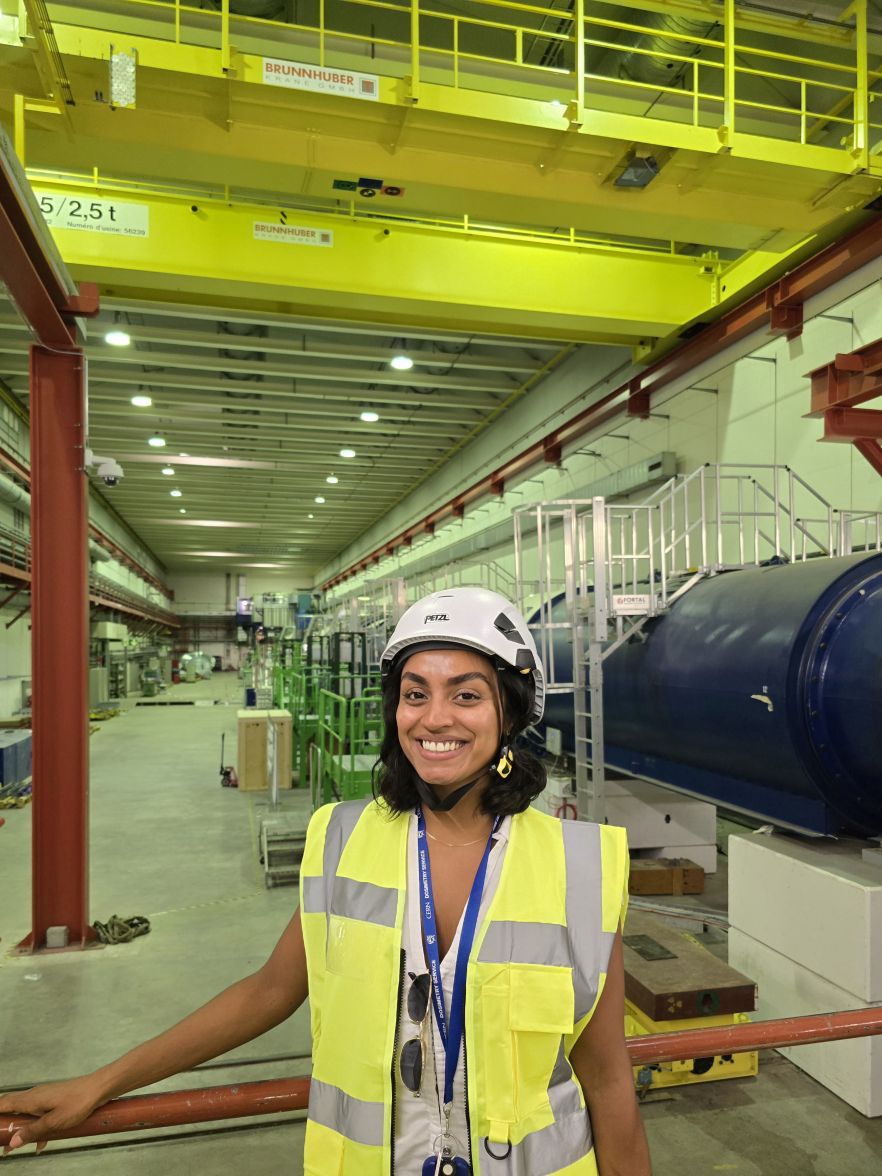
Anika Raihan studied Mechanical Engineering at Queen Mary and now works as a Mechanical Engineer at the world-famous CERN in Geneva, within the Beams Department and Experiments Area Group. She told us about her work, and looked back at how her time at Queen Mary helped prepare her.
"There isn't really a typical day"
One of the things I enjoy most is that there isn't really a typical day. Some days I'm at my desk reviewing drawings and technical documentation, developing dismantling methodologies or contributing to risk assessments. Other days I'm underground in the experimental area investigating equipment, attending site inspections or meeting engineers and contractors to work through how an activity can safely and practically be carried out.
The work is very multidisciplinary, so I regularly work with specialists in areas such as structures, transport and lifting, cryogenics, cooling and ventilation, and safety. One example of a project I've worked on involved developing the methodology for removing a magnet assembly weighing approximately 34 tonnes, which required us to consider everything from isolations and draining to temporary rails, lifting and transport.
One thing I've learnt is that engineering isn't always about being given a clearly defined problem and finding the answer. Sometimes the first challenge is figuring out what information is missing, who you need to speak to and how you bring everyone's expertise together into a safe and practical solution.
My journey to CERN
I first visited CERN in October 2015 on a school trip. It felt huge and mysterious, and very far removed from anything I could imagine myself being part of. I definitely wasn't walking around thinking I would work there one day!
I went on to study Mechanical Engineering at Queen Mary and graduated with an MEng in 2023. I then joined Murphy as a Graduate Mechanical Engineer, working on large infrastructure projects and gaining experience in mechanical design and calculations, CAD, piping systems, site work and engineering safety assessments.
CERN had always stayed in the back of my mind. While working at Murphy, I regularly checked the CERN careers page and applied for opportunities. I genuinely thought it was a long shot, and I was rejected several times over the course of about a year.
Eventually, a Mechanical Engineering position came up that aligned really well with the experience I had developed in industry. Looking back, those earlier rejections are actually an important part of my journey. They didn't mean I wasn't capable of working at CERN - I just hadn't found the right opportunity at the right time yet.
The interview itself was much more relaxed and personal than I expected. My future supervisor seemed genuinely interested in getting to know me rather than simply going through my CV. I remember him asking how I felt about moving abroad and adapting to another country. As the child of immigrant parents, my response was that adapting between different cultures had already been part of my life.
In January 2026, just over ten years after visiting CERN as a school student, I moved to Geneva to start working there as a Mechanical Engineer.
I've even trained as a CERN Guide, so the tours I once received as a young student are now tours I can give to other young people.
I've also had the opportunity to return to Queen Mary representing CERN at the Placement & Internships Bootcamp, which was a particularly special full-circle moment for me.
How Queen Mary prepared me
Queen Mary gave me a broad technical foundation, but some of my favourite learning came through project work.
One project I particularly enjoyed was my third-year project on the topology optimisation of a solar-tree structure. The project involved designing and optimising a structure for solar panels while considering factors such as structural stability, wind loading, material use and energy generation. I particularly loved the design and 3D-modelling side of it.
Looking back, there's quite a clear connection between what I enjoyed then and what I enjoy now. The scale and complexity are obviously very different, but I still enjoy looking at a physical engineering problem, understanding its constraints and working out how something can be designed, modified, moved or taken apart.
University also taught me skills beyond calculations. Project work teaches you how to deal with uncertainty, communicate your ideas and keep working at a problem when your first approach doesn't work. Those are skills I use constantly now.
My favourite memories
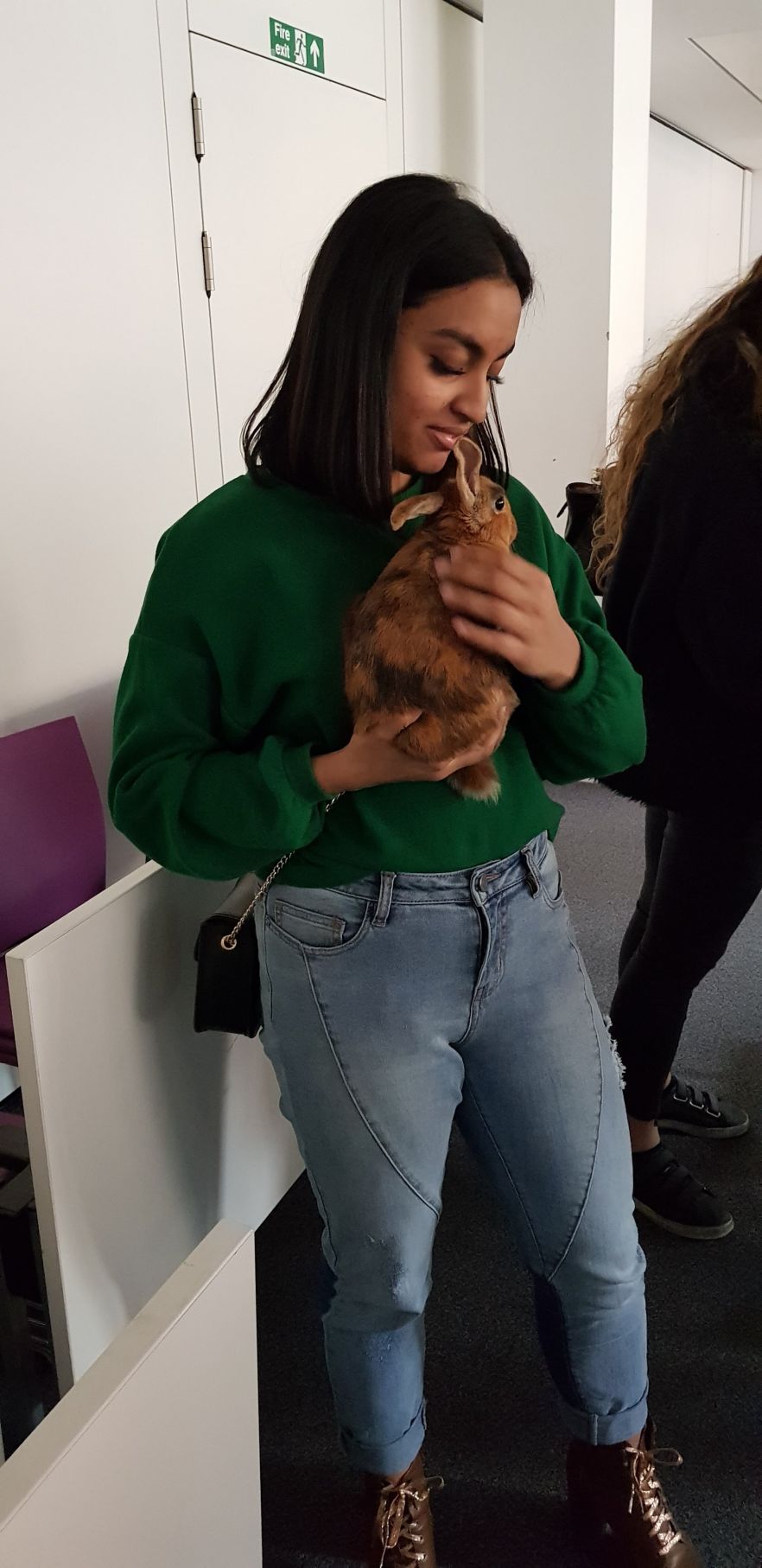
I really enjoyed getting involved in the social side of university. I was part of the Fashion Society, which gave me the opportunity to take part in a fashion show at UCL. I loved having a creative outlet alongside engineering and being able to nurture a completely different side of myself.
I also worked part-time for Queen Mary as a receptionist, which meant I met lots of different people and felt much more involved in university life. And I remember one event when the university team brought animals in during exam periods as a way to "keep calm".
And then there were the late-night study sessions with my friends! Engineering could definitely be challenging, but we encouraged each other through deadlines and exams. Looking back, those are some of the memories I value most.
I think one of the best things about my Queen Mary experience was that I wasn't only an engineering student. I had the opportunity to explore other interests and parts of myself at the same time.
My biggest piece of advice would be...
...don't rule yourself out, and don't let rejection make that decision for you.
CERN felt like a long shot to me. I applied several times over the course of about a year and was rejected. Of course that was disappointing, but I kept trying. Eventually, the right position came up at the right point in my career and the experience I had developed matched what the team needed.
That taught me that rejection isn't necessarily a verdict on what you're capable of. Sometimes you simply aren't the right fit for that particular role at that particular moment.
I think this is especially important for young people who come from backgrounds where they don't necessarily see many people around them working in places like CERN. I'm the child of immigrant parents, I went to a state school in London, and when I first visited CERN as a teenager I couldn't imagine myself working there. Ten years later, I'm a Mechanical Engineer there.
So my advice would be to keep learning, keep applying and allow yourself to be ambitious even when something feels out of reach. You don't need to have everything figured out, and your first job doesn't have to define your entire career.
Most importantly, give yourself the chance before deciding that something isn't for you.