

News
Dr Rehan Shah wins Queen Mary SEED Educator Prize, students win SEED awards
25 August 2026


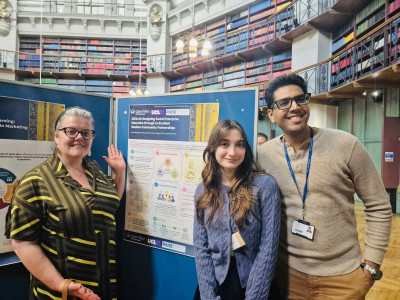
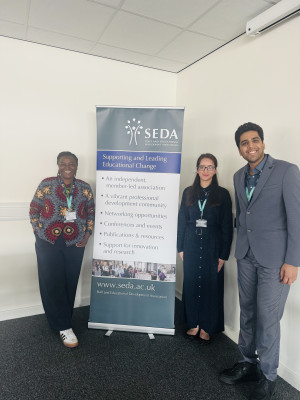
Dr Rehan Shah has won Queen Mary's Student Enhanced Engagement and Development (SEED) Annual Educator Prize for 2025-26, awarded to only one of three academic staff recipients across the university each year for recognition of significantly impactful co-creation scholarship work with students. The panel commented on how Dr Shah had "engaged co-creatively with students and the extent to which the co-creative activities have led to impact." They also noted how "it is work like this which continues to enhance and shape education at QMUL, and on behalf of the university community we thank you for your contribution."
Dr Shah has an active scholarship research group 'QMULtipliers', which has had 20 undergraduate and postgraduate student members thus far, 13 of whom have already successfully received SEED awards from Queen Mary Academy for their co-creation scholarship contributions across 11 different scholarship projects, several of them being funded, cross-institutional ones. In addition to Dr Shah receiving a certificate for the prize from Queen Mary Academy, two of his group's second-year Design Engineering undergraduate students, Maneeha Siddiki and Sara Hamandi also received SEED awards for their work with Dr Shah on respective cross-institutional scholarship projects.
Maneeha was recognised for her significant contributions as a student research assistant on Dr Shah's project “AI in Academia" which involved conducting an audit of educational developers’ use of, and attitude towards GenAI in higher and further education, in collaboration with Dr Matthew Cole (Hartpury University), Dr Noleen Chikowore (University of Leeds) and funded by a 2025 Staff and Educational Development Association (SEDA) Research Grant.
Maneeha was instrumental in contributing to every stage of the project which included conducting literature reviews on empirical research and institutional policies, designing and disseminating a national UK-wide staff survey, facilitating focus groups with academics and educational developers, and undertaking qualitative and quantitative data analysis. The project generated evidence from 49 survey respondents across 16 UK institutions and featured 3 focus groups involving 13 staff participants from 6 institutions. She worked with academic colleagues to compare interpretations of emerging themes, discussing how educator experiences should be represented in the findings, before agreeing on the final thematic framework. She presented the findings with the team as a poster presentation at QMUL Festival of Education (June 2026), an oral presentation at the SEDA Spring Conference held at Liverpool John Moores University (May 2026) and will produce forthcoming open-access blog articles for the SEDA website and a co-authored research paper for SEDA’s flagship Innovations in Education and Teaching International (IETI) journal.
Sara on the other hand, worked with Dr Shah on a student-community partnership project titled "Social Enterprise Education Design with AI", funded by a 2025 Researching, Advancing and Inspiring Student Engagement (RAISE) Network Research Grant, in collaboration with Prof Anne Preston (UCL), Craig Martin (UCL) and Liza Fletcher (community partner from E17 Films). The project focuses on co-designing (with students and a local East London community organisation (E17 Films)), a template framework for a new, shared social entrepreneurship module/short course using ethical and creative applications of GenAI.
Sara's main contribution was in transforming the learning design into a practical structure for the proposed module. Drawing on established design thinking approaches, she helped shape the process into an iterative cycle of 'Empathise, Define, Ideate, Prototype, Test and Reflect'. She also considered how each stage could support student learning, where community partner involvement could be built in, and how reflection could strengthen the process. This helped move the project from broad aims towards a usable module framework. She presented the findings with the team as a poster presentation at QMUL Festival of Education (June 2026) (which received the 3rd Prize for Best Poster among 62 posters), an oral presentation at the RAISE Annual Conference (Sept 2026) and will produce forthcoming open-access blog articles for the RAISE website and a co-authored research paper for RAISE’s flagship Student Engagement in Higher Education journal.
The panel were exceedingly impressed by both of their contributions work stating that both were "very good applications that clearly explains the project and how you co-created with staff and the community partner". They also noted how the application "demonstrates how you reflected during the process to make the project as successful as possible, how you’ve reflected on all the skills you’ve developed and it's very impressive that you reflected on how to use GenAI responsibly as part of the project and designed it to ensure that AI wasn’t being used to replace human creativity."
| Contact: | Dr Rehan Shah |
| Email: | rehan.shah@qmul.ac.uk |
| Website: | |
| People: | Rehan SHAH |
| Research Centre: | Research in Engineering and Materials Education |