

News
Dr Mouna Chetehouna Presents a QMUL-Led Engineering Education Model at ECE2026
15 July 2026


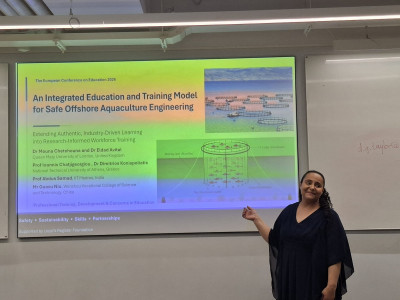
Dr Mouna Chetehouna from SEMS presented a QMUL-led education and training model at the 14th European Conference on Education (ECE2026), organised by The International Academic Forum (IAFOR).
The presentation, titled “An Integrated Education and Training Model for Safe Offshore Aquaculture Engineering”, was delivered within the conference stream Professional Training, Development & Concerns in Education. Led by Queen Mary University of London, the work brings together collaborators from the National Technical University of Athens, IIT Madras and Wenzhou Vocational College of Science and Technology, alongside industry and training partners working across offshore aquaculture, maritime systems, materials, seafood production and vocational training.
The presentation focused on a central challenge in engineering education, which is how research activity, student learning, industry expertise and frontline workforce training can be connected in ways that are educationally meaningful and practically useful. This challenge is particularly significant in offshore aquaculture, a sector with growing importance for food security and sustainable seafood production, but also one that operates in demanding marine environments where safety, infrastructure reliability, energy systems, fish welfare and environmental protection are closely linked.
At the centre of the work is the continued evolution of Authentic, Industry-Driven Learning (AIDL), an educational framework developed within SEMS by Dr Mouna Chetehouna and Dr Eldad Avital. AIDL reframes engineering student projects as authentic, industry-linked and dissemination-oriented learning experiences. In its earlier implementation, the framework embedded industrial mentorship, transnational collaboration and public research dissemination into student project work, while retaining academic rigour through established assessment structures including reports, presentations and viva.
The offshore aquaculture project represents the next stage in the development of this framework. AIDL is being extended from a student-centred project model into a five-year international research, learning and training programme. Through this expansion, the AIDL’s sphere of influence now reaches across academic partners in Greece and India, industry specialists contributing operational knowledge and technical expertise, and frontline training partners in China.
This wider application creates a layered model of participation and knowledge exchange. Students enter the project at multiple levels, from undergraduate summer research and MEng/MSc project work through to doctoral and postdoctoral research. Their work is connected to live engineering challenges, including modelling, simulation, hydrodynamics, materials research, wave-energy integration and deployment studies. Industry partners contribute operational data, specialist training, case-based learning and professional validation, while frontline partners support fishermen, technicians and aquaculture personnel through practical safety and sustainable-operations training.
Within SEMS and through CREME, the work demonstrates how educational scholarship can generate impact beyond modules and cohorts. By extending AIDL into an international offshore aquaculture context, the project connects authentic student learning with research translation, industry co-education, workforce development and sustainable engineering practice. It also contributes to QMUL’s established and growing reputation for engineering education that is globally engaged, evidence-informed and grounded in real-world challenges.
The presentation positioned AIDL as a transferable framework for research-integrated engineering education. Its broader contribution lies in showing how universities can design learning systems in which students engage with live engineering problems, industry partners act as co-educators, end users inform training needs, and educational impact is evaluated beyond academic grades. In doing so, the work contributes to the evolution of STEM education while extending QMUL’s educational influence across international academic, industry and training communities.
| Contact: | Dr Mouna Chetehouna & Dr Eldad Avital |
| Email: | m.c.chetehouna@qmul.ac.uk |
| People: | Mouna CHETEHOUNA Eldad AVITAL |
| Research Centres: | Research in Engineering and Materials Education Intelligent Transport |