

News
Real engineering problems, real data: how Queen Maryteaches engineers to learn and use AI
30 March 2026


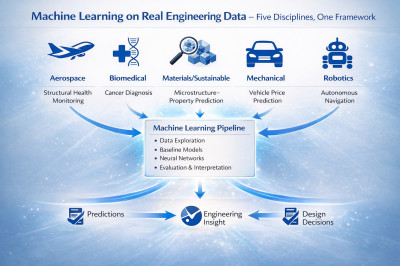
Year Two engineering students at Queen Mary's School of Engineering and Materials Science are building machine learning models on data drawn directly from their own degree disciplines. Rather than working through generic textbook examples, they tackle real prediction and classification problems in structural health monitoring, clinical diagnostics, materials design, automotive engineering, and autonomous robotics, fields where AI is already transforming professional practice.
This is the design philosophy developed by Dr Sathiskumar Anusuya Ponnusami behind a teaching module EMS506: Numerical Methods and Data Science led by Dr Rehan Shah. The module's central conviction is simple: data science is best learnt when the data matters to you. Five fully independent coursework streams are structured around datasets and prediction tasks drawn directly from each student’s engineering discipline.
Aerospace Engineering students predict structural damage from wing-sensor readings; Biomedical Engineering students classify breast tissue samples; Materials Science and Sustainable Energy Engineering students predict mechanical properties from microstructure data; Mechanical Engineering students model vehicle pricing from design parameters; Robotics Engineering students infer robotic navigation decisions from ultrasonic sensor arrays. Together, they demonstrate that machine learning is not a specialism confined to computer science. It is a core competency for the modern engineer, whatever their discipline.
This is what engineering education at Queen Mary looks like at its best: ambitious, relevant, and closely aligned with the professional environments students are preparing to enter.
"The goal is simple: every student finishes having trained machine learning models on data they could genuinely encounter in their first engineering role. That connection to real engineering practice is the whole point. Achieving that at Year 2 is something we are genuinely proud of."
— Dr Sathiskumar Anusuya Ponnusami FRAeS, Senior Lecturer in Engineering AI, Queen Mary
A Scaffolded Pathway: From Classical Models to Neural Networks
Each Coursework track follows the same four-task structure, designed to mirror the progression of the module itself. Students begin with data exploration and preprocessing with their discipline-specific dataset. They then train a classical baseline machine learning model using linear or logistic regression, before moving to more advanced models. Students then build and train a neural network, tackling the real challenges of model design and performance diagnosis. The final task rewards curiosity: students experiment systematically with their model, exploring how changes to architecture and data affect outcomes.
A Template for Contextualised STEM Education at Queen Mary
The approach taken in the module reflects a broader pedagogical commitment within the School of Engineering and Materials Science: that quantitative methods are best learnt in context. By anchoring every data science task in a problem drawn from the student's own discipline, the module removes the abstraction barrier that often makes machine learning appear inaccessible to engineering students.
Dr Ponnusami designed interactive, animation-rich Python notebooks that let students explore and experiment at their own pace. Confidence is built progressively, with each concept encountered multiple times through lectures, IT sessions, and independent application in their coursework, ensuring both depth of understanding and practical competence.
| Contact: | Sathiskumar Anusuya Ponnusami |
| Email: | s.a.ponnusami@qmul.ac.uk |
| People: | Sathiskumar ANUSUYA PONNUSAMI Rehan SHAH Yi SUI |
| Research Centres: | Intelligent Transport Research in Engineering and Materials Education |