

News
China SC PhD studentship on sticky ions!
29 October 2026
(For Chinese students only, rules of China Scholarship Council apply)
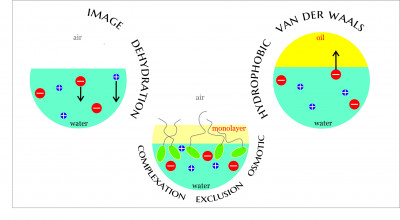
Some ions, like I- and H3O+, tend to stick to hydrophobic interfaces, thus charging them. The reason is not clear. Based on our current knowledge of aqueous electrolytes, H3O+ should really prefer to stay in the water. The studies of the effect contradict each other and none explains all of its features.
This ion-surface attraction plays a key role in phenomena such as activity of stomach enzymes, processes like flotation and oil well stimulation, design of supercapacitors employing graphite electrodes – yet no convincing adsorption model for H3O+ exists to guide formulation problems; no theory predicts its adsorption constant; no ions of similar behaviour have been identified. Even the qualitative nature of this attraction is obscure.
We are looking for a PhD student to investigate the secretive forces that drag sticky ions to surfaces. The aim is to produce understanding and a model of the interaction. The tools will be both experimental and theoretical – the work can be directed more in direction of characterization of charged surfaces or towards analysis of data and developing thermodynamic models, depending on the skills and the preferences of the student. Experiment-lovers, theory-lovers and especially those who hesitate between the two – you are welcome to apply! The applications we are going to target: carbon capture and storage (the charge of the interface between low-pH water and liquid carbon dioxide is essential there); mechanisms of rain (the role of ions for nucleation of water droplets in the atmosphere); and the classical problem – how are salts changing the behaviour of surfactants (numerous formulation problems ranging from shampoos to oil production).
For more information: click here.
| Contact: | Radomir I Slavchov |
| Email: | r.slavchov@qmul.ac.uk |
| People: | Radomir SLAVCHOV |
| Research Centre: | Sustainable Engineering |