

News
Tiny Strains, Big Impact: New Lead-Free Material Enables Tunable Wireless Technologies (Publised in Science Advances)
17 September 2026


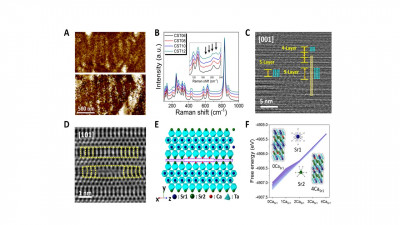
Researchers at Queen Mary University of London have developed a new way to control the electrical properties of materials for future adaptive wireless technologies. The team discovered that introducing a small amount of calcium into a layered ceramic creates tiny internal strains at the atomic scale. These strains generate nanosized polar regions that can respond rapidly and reversibly to an applied electric field.
This approach overcomes a longstanding challenge: materials that can be strongly tuned electrically often suffer from high energy loss and other undesirable electrical properties. The new lead-free ceramic combines strong tunability with relatively low electrical loss and low permittivity, making it attractive for microwave applications. The researchers demonstrated its practical potential by incorporating the material into prototype microwave resonators and antennas, where the operating frequency could be adjusted using voltage or temperature.
The work provides a new materials-design strategy for more adaptable and energy-efficient communication technologies.
| Contact: | Haixue Yan |
| Email: | h.x.yan@qmul.ac.uk |
| Website: | |
| People: | Haixue YAN |
| Research Centre: | Sustainable Engineering |