

News
Scientists generate electricity from ambient moisture using everyday ingredients
21 May 2026


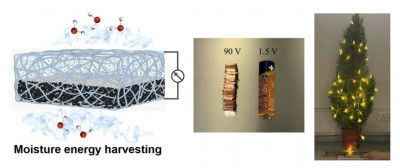
An international research team led by scientists at Queen Mary University of London has developed an innovative method to power wearable electronics using ambient moisture and simple, non-toxic materials commonly found in the kitchen.
In a study published in Nano Energy, researchers from Queen Mary, the University of Warwick, Imperial College London, and Universitas Mercatorum report a highly stable, biodegradable Moisture-Electric Generator (MEG). The device is fabricated from food-grade materials including gelatin, sodium chloride (table salt), and activated carbon, and harnesses humidity, typically a major challenge for electronics, as its energy source.
This approach represents a significant shift in electronic design, transforming atmospheric moisture from a limitation into a functional energy input.
A Sustainable Alternative to Conventional Power Sources
With global electronic waste (e-waste) continuing to rise, the development offers a potentially low-impact alternative to conventional batteries and energy systems. The MEG is manufactured using a simple, water-based process and relies on widely available, non-toxic materials, supporting more sustainable and circular approaches to electronics.
The technology works by absorbing water molecules from the surrounding air or from human skin. As the gelatin-salt solution dries, it self-organises into a three-layered structure. When exposed to humidity, this architecture enables ion movement within the material, generating a continuous and stable electrical output of approximately 1 volt per unit for periods exceeding 30 days.
By connecting multiple units in series, the research team demonstrated scaled performance of up to 90 volts and 5.08 mA, sufficient to power small electronic devices such as a 40-light LED string.
Dr Ming Dong, Postdoctoral Research Associate at Queen Mary University of London’s School of Engineering and Materials Science and first author of the study, said:
“Generating high voltages typically requires complex manufacturing processes or scarce materials. This work shows that it is possible to achieve strong performance using simple, sustainable components. By combining gelatin and salt, we have created a generator that operates using ambient humidity as its sole energy source.”
Dual Function: Power Generation and Sensing
In addition to energy harvesting, the material demonstrates potential as a sensitive, skin-compatible sensor. Because its electrical output responds to small changes in moisture, the system can detect physiological signals linked to humidity variations.
The researchers demonstrated that the device can monitor breathing patterns in real time and detect changes associated with speech through variations in exhaled moisture. It also shows promise for touchless proximity sensing, opening opportunities for integration into wearable health monitoring systems and human–machine interfaces, without requiring a battery.
Biodegradable by Design
A key advantage of the technology is its environmentally benign end-of-life profile. Unlike conventional electronics that rely on plastics and heavy metals, the MEG is designed to degrade safely.
After use, the device can either biodegrade in soil within a few weeks or be dissolved in water, enabling recovery and reuse of its components without hazardous chemicals. This positions the technology as a potential contributor to circular electronics, where materials can be safely returned to the environment or recycled.
Dr Dimitrios Papageorgiou, Reader in Functional Polymers and Composites at Queen Mary and corresponding author of the study, said:
“Our goal was to rethink how electronic materials are designed and manufactured. This research demonstrates that high-performance energy devices can be made from low-cost, environmentally friendly materials. The ability of a gelatin-based system to generate meaningful electrical output highlights the potential scalability of this approach.”
The open-access paper, titled "A biobased moisture-electric generator with self-stratified architecture for physiological sensing and energy harvesting," was published in Nano Energy on 19 May 2026.
Full Journal Citation: Dong, M., Zhang, H., Bilotti, E., Cataldi, P., & Papageorgiou, D. G. (2026). A biobased moisture-electric generator with self-stratified architecture for physiological sensing and energy harvesting. Nano Energy, 155, 112040.
| Contact: | Dimitrios Papageorgiou |
| Website: | |
| People: | Dimitrios PAPAGEORGIOU |
| Research Centre: | Sustainable Engineering |