

News
Queen Mary students win ESA testing slot for high‑altitude space biology mission
31 March 2026


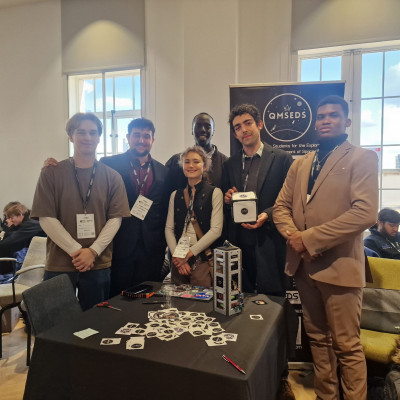
A student team from the Queen Mary Society for the Exploration and Development of Space (QMSEDS) has been selected for a prestigious testing opportunity with the European Space Agency (ESA) through the Fly Your Satellite! educational programme.
Their project, EXCALIBUR (Extremophile Cyanobacteria: Atmospheric Life Investigation for Biological UV Resistance), is a stratospheric balloon experiment investigating the survivability and behaviour of cyanobacteria under the extreme environmental conditions found near the edge of space.
As part of the programme, eight members of the EXCALIBUR team will visit the ESA CubeSat Support Facility at the Galaxia campus in Belgium, where they will conduct a series of environmental tests designed to validate their hardware. Using ESA’s thermal vacuum chamber and electrodynamic shaker table, the students will assess the experiment’s performance under thermal, vacuum, and mechanical conditions representative of flight to approximately 34 km altitude and landing.
Project lead Joshua Amar highlighted the educational value of the opportunity: “Our selection for this programme is a fantastic and valuable opportunity for the team, not just to test our hardware, but for our team members to learn about product verification and qualification, engineering standards, and developing and executing test plans for space hardware.”
Following this success, the team also held a Preliminary Design Review in the School of Engineering and Materials Science (SEMS), attended by academics from SEMS, the School of Biological and Behavioural Sciences, and the School of Physical and Chemical Sciences. The review provided the team with expert feedback on experimental design, and testing approaches ensuring the that the project continues to meet both scientific objectives and engineering best practice as it progresses towards flight.
The views expressed in this article are those of the authors and do not reflect the official opinion or endorsement of the European Space Agency.
| Contact: | Declan Carolan |
| People: | Declan CAROLAN Ranjan VEPA Himadri GUPTA Angadh NANJANGUD |
| Research Centre: | Intelligent Transport |