

News
Unlocking the secrets behind 20% efficient organic solar cells
9 March 2026


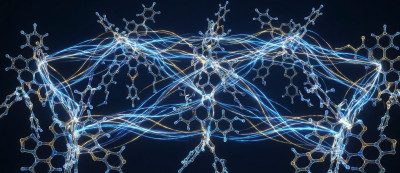
New research has revealed how next-generation solar materials move energy with record breaking efficiency.
Researchers at Queen Mary University of London, working closely with collaborators at Imperial College London and the Spanish National Research Council (CSIC), have uncovered how the latest generation of organic solar cell materials achieve record‑breaking efficiencies of over 20%. Their findings provide long‑sought answers to a major puzzle in the field and lay out new design rules for future molecular photovoltaics.
Organic solar cells — which use carbon-based molecules or polymers to absorb sunlight — offer a lightweight, flexible and potentially more sustainable alternative to traditional silicon photovoltaics. Over the past two decades, their power‑conversion efficiency has climbed from around 2% to over 20%, thanks largely to a new class of molecules known as non‑fullerene acceptors (NFAs), particularly the highly successful “Y‑family” of materials such as Y6. But until now, scientists have not fully understood how these materials reach such high efficiencies.
Rethinking How Charges Are Created
Traditionally, organic solar cells rely on a junction between two molecular materials — an electron donor and an electron acceptor — to split tightly bound excitons into free charges. This process normally requires a large energetic “offset” between the materials, which comes at a cost: the larger the offset, the lower the voltage and overall efficiency of the device.
However, the latest NFAs break this rule, achieving high efficiencies with much smaller energy offsets. Some studies have even suggested that charges could be generated directly within the molecular film, without needing a clear donor–acceptor interface.
A Combined Experimental–Computational Breakthrough
To solve this puzzle, a team from Queen Mary’s School of Physical and Chemical Sciences, with researchers at Imperial College London, combined experimental device measurements with a new computational model capable of simulating how excited electronic states spread out, or delocalise, across the molecular network.
By comparing simulated and experimental data, the team found that this delocalisation plays a critical role in enabling efficient charge generation at low energetic cost.
“What our results make clear is that we can no longer look at these molecules in isolation,” said Dr Flurin Eisner, Lecturer in Green Energy at Queen Mary University of London and co-author of the study. “The secret to their high efficiency lies in how the energy is shared and spread out across an entire molecular network. It’s this teamwork at the nanoscale that allows the charges to separate so effectively without needing a massive energetic push.”
New Rules for Molecular Design
The team identified key structural characteristics of the highest‑performing materials — including both their chemical structure and their nanoscale arrangement — that make them exceptionally effective at transferring energy across the film.
The researchers also tested whether the new materials were capable of generating photocurrent without a traditional heterojunction interface. While this is not yet achievable, the results point clearly to how the materials could be improved to move closer to this goal.
Towards Next‑Generation Solar Materials
This work provides practical, evidence‑based design rules for chemists and materials scientists looking to push organic solar cell performance even further. Future efforts, the team suggests, should focus on:
- lowering the energy required for molecular reorganisation
- reducing structural disorder
- increasing intermolecular interactions
The research was supported by UKRI (ATIP programme grant) and the UKRI ERC underwrite scheme (POTENtIAl) via collaboration with Prof Jenny Nelson (Imperial College London), and the Spanish CSIC via collaboration with Prof Campoy‑Quiles at ICMAB, Barcelona (project DOMMINO).
| Contact: | Flurin Eisner |
| Email: | f.eisner@qmul.ac.uk |
| Website: | |
| People: | Flurin EISNER |
| Research Centre: | Sustainable Engineering |