

News
Queen Mary University of London Opens New High Velocity Impact Laboratory
12 February 2026


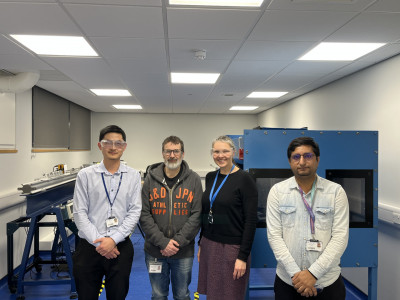
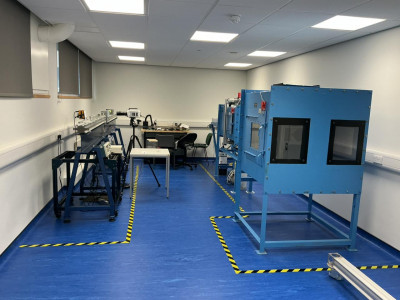
We are delighted to announce the official opening of our new High Velocity Impact Lab, led by Dr Wei Tan, marked by a visit from Prof Hazel Screen (Head of School) alongside Doug Thomson (Workshop Manager). Their visit celebrated the completion of a major new experimental facility and the launch of our next-generation high-velocity impact capabilities at the School of Engineering and Materials Science.
Following significant construction work, the lab now occupies a 10 m × 6 m dedicated space—a rare and valuable asset in London, where laboratory space is extremely limited. This purpose-built room enables us to house two major impact rigs side by side, significantly expanding our experimental capacity.
On the left-hand side of the laboratory is our bespoke liquid impact rig, uniquely designed and built at Queen Mary. The system is capable of firing a curved-front water jet at velocities between 70 m/s and 300 m/s. It is coupled with a Hopkinson bar, allowing measurement of high-frequency impact signals up to 1 GHz. The facility is further integrated with high-speed imaging, enabling simultaneous capture of droplet formation and stress-wave propagation within solids. These combined capabilities allow us to unravel crucial impact-driven mechanical behaviour, providing fundamental insight to guide the development of improved leading-edge protection materials, particularly for wind energy applications. The rig is also under further development into a split-Hopkinson pressure bar for high-strain-rate material characterisation.
On the right-hand side of the lab sits an industry-certified gas gun for high-velocity solid-to-solid impact testing. The system can achieve impact velocities in excess of 900 m/s, supporting experimental studies on a wide range of high-performance materials. Dual-camera imaging is used in conjunction with digital image correlation (DIC) to quantify material deformation and failure during impact events.
This new facility represents a truly collaborative achievement. We would like to thank the Faculty for their strong support, Hazel for her continuous support of the laboratory development; Ji Yoon (Technical Manager); Ricardo Saroyan-James and his Estates team for delivering the construction work; Doug and the workshop team for fabricating the main setup and supporting structures. Special thanks also go to our team members: Devender Kumar for the design and assembly of the liquid impact rig, Haoming for assistance with test setup, and Wenqi for the design and upgrade of the solid-impact gas gun, alongside many other staff and colleagues who contributed to making this facility a reality.
Dr Wei Tan, the PI of this lab, said: “I am delighted and grateful for the support from the University, Faculty and School in facilitating the allocation and renovation of the space and enabling the establishment of the laboratory. This lab allows us to observe impact physics in ways that were previously very challenging— from water droplet impact to stress waves travelling through advanced materials. By linking fundamental mechanics with high-speed measurement, we aim to design the next generation of protective materials for wind energy and aerospace structures.”
We look forward to leveraging the High Velocity Impact Lab as a platform for wide-ranging collaboration and impactful research across wind energy, aerospace, and related high-performance engineering sectors.
| Contact: | Wei Tan |
| People: | Wei TAN |
| Research Centres: | Intelligent Transport Sustainable Engineering |