

News
Research on Structural Origin of Morphotropic Phase Boundary in Advanced Perovskite Ferroelectric Oxides published in JACS
6 February 2026


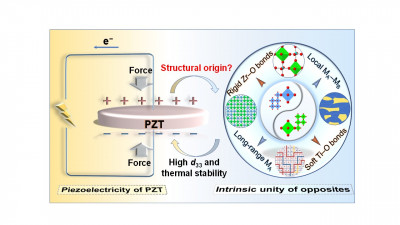
Perovskite ABO3-type PbZr1-xTixO3 (PZT) ferroelectric oxides represent the most important piezoelectric ceramics owing to their high piezoelectric coefficients, thermal stability, and low-cost tunability across diverse applications. Their exceptional electromechanical response is conventionally attributed to the morphotropic phase boundary (MPB). However, despite decades of structural and chemical investigation, the structural origin of this enhanced response remain insufficiently understood. Existing models based mainly on average crystallographic structure cannot fully explain its high thermal stability, anomalous polarization rotation, domain-wall mobility, and strong electromechanical coupling that are directly related to the high piezoelectric coefficient in MPB compositions.
In this work, we identify how PZT accommodates a structural unity of opposites. Through combined neutron total scattering, reverse Monte Carlo modelling, electron microscopy, and first-principle calculations:
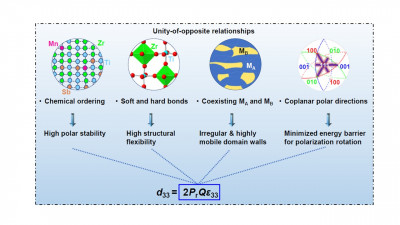
- We reveal a pronounced anti-self-clustering chemical ordering between Zr and Ti, which is driven by the mismatch between ionic Zr–O (“hard”) and more covalent Ti–O (“soft”) bonds. Such chemical ordering generates a coherent soft‒hard compatible BO6 network that lowers local stress and Coulombic energy while enhancing the octahedral flexibility. The perovskite lattice becomes simultaneously robust and flexible, stabilizing the polar structure once formed under poling, and enhancing the polarization-strain coupling associated with octahedral deformation.
- We further show that the long-range ordering monoclinic phase in fact contains short-range disordering MA and MB polar states, whose polarization vectors remain coplanar. This multiscale spatial ordering produces nanodomains separated by irregular and highly mobile domain walls. The local disordered structure appears as a cooperative polar diversity embedded within a macroscopically ordered framework. Follow this coherence, the structural rigidity and flexibility are not in competition but in a compatible state, enabling high thermal stability and facile polarization rotation under electric field.
These complementary opposites, rigid and soft bonds, long-range order and local disorder, distinct polar states and coplanar polarization directions, collectively lead to high remnant polarization, enhanced electromechanical coupling, and large permittivity characteristic of MPB compositions. Our work reveals that high piezoelectricity in PZT emerges not from a single structural factor, but from a cooperative duality existed in the chemical bonding and polar structure topology. This duality-based insight provides a new chemical perspective for understanding and designing advanced ferroelectric, piezoelectric and dielectric materials.
| Contact: | Haixue Yan |
| Email: | h.x.yan@qmul.ac.uk |
| Website: | |
| People: | Haixue YAN |
| Research Centre: | Sustainable Engineering |