

News
Dr Jae-Hwan Park contributes to reports on trust-based cross-border data cooperation in Central and East Asia published by UNESCAP
2 January 2026


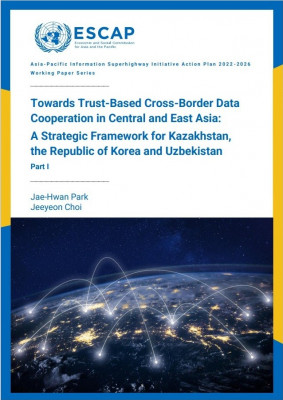
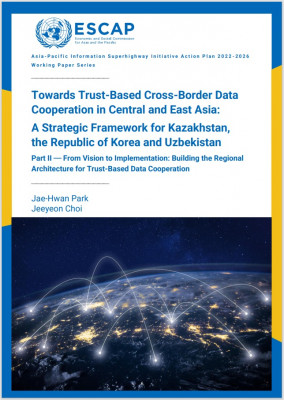
UNESCAP (United Nations Economic and Social Commission for Asia and the Pacific) have published two reports on cross-border data collaboration between Kazakhstan, the Republic of Korea and Uzbekistan. The strategic framework was developed partly by Dr Jae-Hwan Park.
Part I – Strategic Foundations
As data becomes a core driver of economic growth and public-sector innovation, cross-border data cooperation is increasingly important for countries at different stages of digital transformation, including Kazakhstan, the Republic of Korea and Uzbekistan.
Developed under the guidance of the United Nations Economic and Social Commission for Asia and the Pacific (ESCAP), Part I establishes the strategic foundations for trust-based data cooperation among the three countries. Rather than focusing solely on technology or regulation, the report emphasises governance, institutional trust and policy alignment.
The framework proposes a realistic, modular approach that respects national differences while supporting gradual, value-driven cooperation across Central and East Asia.
Part II – From Strategy to Implementation
Building on Part I, Part II focuses on how trust-based cross-border data cooperation can be implemented in practice. It highlights the importance of institutional capacity, sustained coordination mechanisms and adaptable governance arrangements beyond technology or legal harmonisation alone.
Part II examines national data infrastructures, existing bilateral and multilateral initiatives, stakeholder coordination challenges, and the legal, regulatory and ethical conditions required for interoperability and public trust. It concludes with a practical road map for trilateral implementation, offering strategic recommendations for the three governments and for ESCAP.
Together, Part II translates strategic vision into actionable steps toward a resilient and trustworthy regional data ecosystem.
| Contact: | Jae Hwan Park |
| Email: | jae-hwan.park@qmul.ac.uk |
| People: | Jae-Hwan PARK |