

News
Metal vapour plumes quantified and validated with physics-based modelling: new study in Advanced Science
18 December 2025


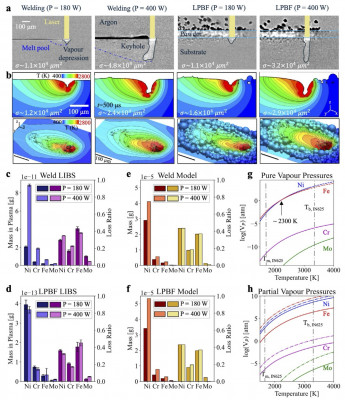
The study, conducted by Dr Chinnapat Panwisawas at Queen Mary School of Engineering and Materials Science, in collaboration with University College London, Shimane University, The European Synchrotron Radiation Facility (ESRF) and Rutherford Appleton Laboratory, has resulted in a publication in Advanced Science, Quantifying additive manufacturing vapour plumes using laser-induced breakdown spectroscopy, synchro….
Understanding vaporization phenomena in laser powder bed fusion (LPBF) additive manufacturing has proven challenging; the links between laser-induced metal vaporization, rate of elemental loss, and composition irregularities remain unclear. Here, the vapor plume composition and preferential vaporization effect is quantified during LPBF, using in situ 1 kHz laser-induced breakdown spectroscopy with correlative X-ray synchrotron radiography, multi-physics simulations, and energy dispersive X-ray
spectroscopy.
It is demonstrated that vaporization increases under keyhole mode, and preferential vaporization causes elemental loss rates of Ni ≈ Fe > Cr > Mo in a Ni-based superalloy, IN625. It is found that the melt pool temperature (T ≈2300 K) can be approximated by cross-referencing vapor pressures, and Raoult’s law inadequately describes preferential vaporization. Three simulation approaches are compared to show that introducing temperature-dependent thermophysical properties improves model predictions. The insights into the vapor dynamics of laser-processed IN625 enhance the understanding of compositional changes and elucidate methods to optimize simulations.
Cite: A.C.M. Getley, S. Hocine, J. Shinjo, C. Panwisawas*, M. Majkut, A. Rack, P.D. Lee, C.L.A. Leung (2026) Quantifying additive manufacturing vapour plumes using laser-induced breakdown spectroscopy, synchrotron X-ray radiography and simulations, Advanced Science. e13652. DOI: 10.1002/advs.202513652
| Contact: | Chinnapat Panwisawas |
| Email: | c.panwisawas@qmul.ac.uk |
| Website: | |
| People: | Chinnapat PANWISAWAS |
| Research Centre: | Intelligent Transport |