

News
Researchers model tumour regrowth to tackle one of brain cancer’s biggest challenges
17 December 2025


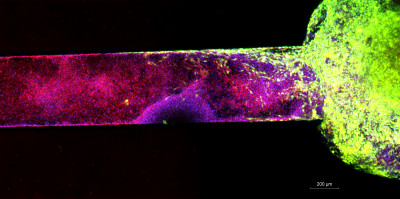
Researchers have taken an important early step towards recreating how aggressive brain tumours spread through healthy tissue, using a miniature “organ-on-a-chip” system designed to mimic the human brain. The work, published in In Vitro Models, could help scientists better understand why these tumours so often return after surgery.
Gliomas are the most common primary brain tumours in adults and require highly precise surgical removal. However, they often cannot be completely excised, resulting in recurrence rates of up to 95%.
Current clinical measurement techniques do not adequately capture cellular behaviour during tumour recurrence. To address this gap, Dr Chris Chapman and his team have developed an on-chip in vitro platform that enables the assessment of glioblastoma interactions with healthy neural cells within engineered microchannels.
Using this system, the researchers found that glioma cells spread more extensively when grown alongside healthy neural cells (co-culture) than when grown alone (monoculture). They also observed differences in proteins associated with tumour aggressiveness and neuroinflammation in co-cultured cells, compared with monocultures. These findings support previous evidence that glioma cells actively modify the neural environment to facilitate infiltration into healthy tissue.
The team believes their on-chip model will provide valuable insights into how glioma cells interact with and invade healthy tissue. In doing so, it has the potential to support the development of improved techniques to measure and treat tumour regrowth, addressing a critical need in the management of tumour recurrence.
This study represents the first research paper from Dr Chapman’s group and was primarily led by Joshua Daoud, who began his PhD earlier this year.
Dr Chapman said: “It has been great to work with the Centre for Predictive In Vitro Models at Queen Mary to develop a neural organ-chip system for our work with glioblastoma. I am excited to see how this research progresses as we increase the complexity of the model and move towards greater relevance for patient-specific disease states.”
| Contact: | Christopher Chapman |
| Email: | christopher.chapman@qmul.ac.uk |
| People: | Christopher CHAPMAN |
| Research Centre: | Bioengineering |