

News
Talk to your journey planner: How AI brings conversation to public transport
7 October 2026



Talk to your journey planner: How AI brings conversation to public transport
A new Queen Mary study introduces ChatPlanner, an AI framework that lets travellers ask for a quieter, step-free, safer or more scenic journey in ordinary language, and builds those wishes directly into the route search. Tested on London's public transport network, it reliably delivered journeys that travellers could actually make, whereas a state-of-the-art general-purpose AI model equipped with mapping tools frequently fell short.
Beyond the fastest route
Most journey planners focus on travel time and the number of changes, and treat personal needs as filters applied after routes are found. The best route for a wheelchair user, or a parent with a pushchair at rush hour, may therefore never be considered.
A new study sets out a different approach. It appears in Transportation Research Part C: Emerging Technologies, one of the most influential journals in transport research and a global reference point for how artificial intelligence and other emerging technologies are reshaping the way people travel and how cities function. It forms part of the journal's special issue Foundation Models and Large Language Models in Urban Mobility, the first the journal has devoted to foundation models. This marks a landmark moment as the AI behind tools like ChatGPT reaches the world of transport. The issue brings together work on how such AI can help cities tackle congestion, inequality, safety and climate resilience.
The paper is authored by Tingting Yang and Dr Jun Chen from the School of Engineering and Materials Science (SEMS), together with Chenhao Xue from the University of Oxford and the Oxford e-Research Centre. The research was conducted under the supervision of Dr Chen.
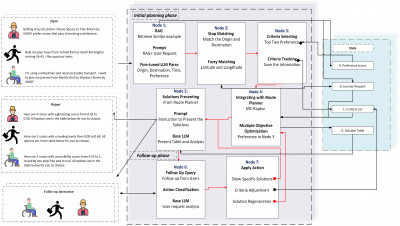
ChatPlanner combines a large language model, the technology behind modern conversational AI, with a multi-criteria route-search algorithm. Travellers describe their journey in their own words, and the system works out how much accessibility, crowding, safety and sightseeing matter to them. It then searches for routes that reflect those priorities, including options that standard planners overlook. To teach the system to understand the language of travel, the team trained it on requests from eight types of traveller, from daily commuters to families with children and older people, across everyday situations such as rush hour and bad weather.
The design is what makes it dependable. The language model only interprets what the traveller wants, while a dedicated routing algorithm works out the journey using real timetable data. This avoids the wrong stations, non-existent connections and missing legs that appeared when a general-purpose AI model was asked to plan routes itself.
"We hope this work contributes to more conversational, inclusive and human-centred public transport planning," said Tingting Yang.
The paper is published open access and is free to read.
Cite: T. Yang, C. Xue, J. Chen* (2027) ChatPlanner: A large language model framework for personalized public transit routing, Transportation Research Part C: Emerging Technologies, 194, 106017. DOI: 10.1016/j.trc.2026.106017
| Contact: | Kerry Evans |
| Email: | k.evans@qmul.ac.uk |