

News
Why graphene’s electrons have been counted the wrong way for decades
9 September 2026


The standard method for extracting charge-carrier density from electrical measurements overcounts carriers in graphene by a factor of two to five, a new Queen Mary study shows — meaning reported mobilities have been systematically underestimated, and the best samples may be far better than the record books say.
A puzzle hiding in plain sight
Two numbers describe how well a material conducts electricity: how many charge carriers it has, and how easily they move — the mobility. Neither can be measured directly. Instead they are inferred from two routine measurements, the Hall effect and the electrical resistance, using textbook formulas developed for semiconductors such as silicon.
For years those formulas have produced a puzzle. Nominally identical graphene samples, made the same way, report mobilities that differ by a factor of ten. Sample quality has usually taken the blame.
Counting only the electrons that can move
A study published in Nano Letters by Dr Yiwei Sun from the School of Engineering and Materials Science (SEMS) and the University of Birmingham, together with Dr Oliver Fenwick (SEMS), Dr Dimitrios Papageorgiou (SEMS), Professor Sir Colin Humphreys (SEMS) and Professor David Dunstan (School of Physical and Chemical Sciences), with collaborators Dr Matthew Coak at the University of Birmingham and Dr David Holec at Montanuniversität Leoben in Austria, argues that the blame lies with the formulas.
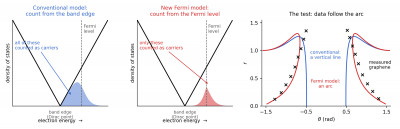
The textbook method counts every electron above the edge of the conduction band as a carrier. In a semiconductor, where an energy gap separates the bands, that is exactly right. But graphene is a semimetal: it has no gap, and electrons fill the band continuously up through the Fermi level — the energy that separates occupied from empty states. Only electrons close to that level can respond to an electric field; those deeper in the band are locked in place by the filled states around them.
“Counting every electron in the band is like counting every person in a packed stadium to explain the flow through the exits,” said Dr Sun. “Only the people near the exits are actually moving. The others are there, but they’re not going anywhere.”
The team’s “Fermi model” changes the counting rule: carriers are counted from the Fermi level rather than from the band edge. In graphene at typical doping the difference is a factor of two to five — and because mobility is obtained by dividing the measured conductance by the carrier density, every overcount of carriers becomes an equal undercount of mobility.
A test with no adjustable knobs
The difficulty with any new counting rule is proving it. Conventional carrier extraction has a hidden advantage: it comes with adjustable quantities — the mobility, and how it varies with doping and temperature — that can be tuned to reproduce almost any measurement. A method that can always be made to fit can never be shown to be wrong.
The researchers’ solution was a new way of plotting the data in which those adjustable quantities cancel out entirely, so that each theory makes a single fixed prediction. In these “double-normalized polar” coordinates the conventional model predicts a vertical line and the Fermi model predicts a smooth arc — and no choice of material parameters can turn one into the other.
Five independent graphene datasets — measurements on four graphene-on-sapphire samples, and published data on ultraclean graphene from Cornell University — all follow the arc.
“For the first time, the conventional model was in a position where it could fail,” said Dr Sun. “And it did — while the Fermi model matched every dataset with zero fitting parameters.”
Why nobody noticed
The team also explains why a flaw in such a widely used method went unnoticed for so long. Whenever the Fermi level sits inside an energy gap, as in silicon or gallium arsenide, the new counting rule reduces exactly to the old one — so decades of success in semiconductors are entirely consistent with the correction. The two rules only part company in metals and semimetals, where the semiconductor formulas were borrowed without a second look.
Better than we thought
The most immediate consequence is for graphene’s record books. Reanalysed with the corrected count, the team estimates that the highest-quality graphene samples may have intrinsic mobilities exceeding 300,000–500,000 cm²/V·s — well beyond current record claims — and that mobility benchmarks across the two-dimensional materials literature will need re-evaluation. The same correction applies to other materials whose electrons behave like graphene’s, including Weyl semimetals and the surface states of topological insulators.
“The best graphene is even better than we thought,” said Dr Sun. “We just hadn’t been counting it properly.”
The paper is published open access in Nano Letters. The team also pays tribute to the late Dr Theo Kreouzis from Queen Mary University of London, whose early insights and enthusiasm helped shape the work.
| Contact: | Yiwei Sun |
| Email: | yiwei.sun@qmul.ac.uk |
| Website: | |
| People: | Yiwei SUN Oliver FENWICK Dimitrios PAPAGEORGIOU Colin HUMPHREYS |