

News
Dr Sathiskumar Ponnusami delivers invited lecture on next-generation Aerospace Materials at Ceramitec 2026 in Munich
31 March 2026


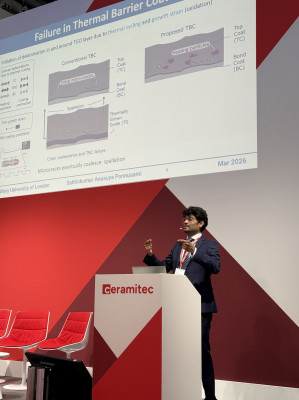
Dr Sathiskumar Anusuya Ponnusami, Senior Lecturer in Engineering AI at the Centre for Intelligent Transport, Queen Mary's School of Engineering and Materials Science, delivered an invited lecture at Ceramitec 2026 in Munich, one of the world's leading international trade fairs and conferences for advanced ceramics and ceramic technologies.
Held at Messe München from 24th to 26th March 2026, the event brought together over 480 exhibitors from 38 countries and more than 12,000 visitors from 70 nations, drawing manufacturers, scientists, engineers, and industry decision-makers from across the global ceramics community.
His lecture, 'Multifunctional Aerospace Ceramics: From Self-Healing Coatings to Stealth Composites', was delivered as part of the conference session on Advanced Ceramics in Aerospace and Sustainable Energy Applications, sponsored by the American Ceramic Society (ACerS). The session brought together leading researchers from across Europe, including colleagues from the German Aerospace Center (DLR) and Politecnico di Torino, reflecting the international standing of the field and the researchers shaping it.
Bridging Physics and Data: A New Approach to Materials Design
The lecture addressed one of the central challenges in next-generation aerospace materials development: how to design and engineer ceramic composites that perform reliably in some of the most demanding operating environments in modern engineering. Dr Ponnusami presented how predictive modelling tools, combining physics-based simulation with data-driven machine learning, are enabling a new generation of ceramic composites for aerospace applications. From self-healing thermal barrier coatings that repair themselves under service conditions at extreme temperatures, to ceramic composites engineered for electromagnetic absorption, the presentation covered a range of applications where the unusual combination of properties offered by ceramics and their composites becomes decisive.
An Interview on the Future of Aerospace Ceramics
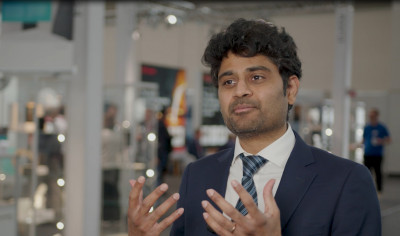
Alongside the lecture, Dr Ponnusami gave an interview at Ceramitec 2026 on the broader scope and potential of ceramic composites for aerospace. He discussed the distinctive characteristics that make these materials so relevant to the sector: their capacity to withstand temperatures that would destroy conventional metallic alloys, to maintain structural integrity under mechanical load, and to do so at a fraction of the weight. The conversation reflected a wider shift in how industry now thinks about ceramics: not as a niche specialist material but as an enabling technology for the next generation of aircraft and space vehicles.
Research at the Intersection of Materials, Mechanics and Computation
Dr Ponnusami's work sits at the intersection of materials engineering, mechanics and machine learning. His research group within the Centre for Intelligent Transport at Queen Mary develops predictive tools that connect microstructure to performance, understand how and why materials fail across scales, and guide the design of advanced aerospace materials and structures.
The invitation to speak at Ceramitec 2026 reflects the international visibility of this research and positions Queen Mary's School of Engineering and Materials Science at the forefront of a field with direct relevance to net-zero aviation, defence, and sustainable energy.
| Contact: | Sathiskumar Anusuya Ponnusami |
| Email: | s.a.ponnusami@qmul.ac.uk |
| Website: | |
| People: | Sathiskumar ANUSUYA PONNUSAMI |
| Research Centre: | Intelligent Transport |