

News
Year 12 students solve real engineering mysteries using AI
16 March 2026


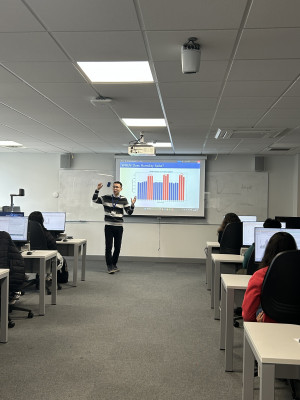
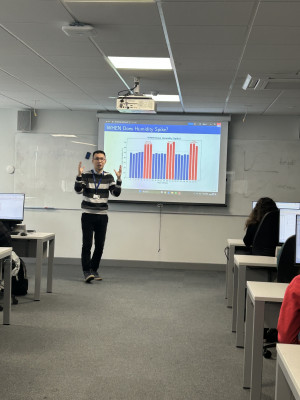
Students become 'Materials Detectives' for a day
Twenty-six Year 12 students from schools across London and South East England visited Queen Mary's Mile End campus on 28th February for an interactive workshop that challenged them to solve two data mysteries — and every team cracked both cases.
In the first investigation, teams analysed factory data to work out why a phone screen production line was producing cracked screens. In the second, they used AI-assisted data analysis to determine why a football team kept losing certain matches. Both mysteries required the same core skill — identifying patterns in data and building a causal explanation — but applied it to very different contexts.
"The format is deliberately designed so you don't need any engineering background to get started," said Dr Yiwei Sun from the School of Engineering and Materials Science (SEMS), who designed and led the workshop. "You just need to be curious about why something is going wrong and willing to look at the evidence."
100% success rate — and a surprise finding about AI
Every team correctly identified the root causes in both mysteries: humidity and shift patterns in the phone screen case, and travel distance and fatigue in the football case. This mirrors results from the same 'Detective' approach used with 240 Year 3 undergraduates at Queen Mary's joint programme with Northwestern Polytechnical University in Xi'an.
Surveys taken before and after the workshop showed statistically significant improvements in students' confidence in explaining AI and their comfort with analysing data — both increasing by more than one full point on a five-point scale.
An unplanned finding emerged when students were asked why the second mystery felt easier. Seventy percent of teams spontaneously credited the AI tools they had been introduced to between the two investigations. One student wrote: "AI was quick to identify patterns that I would sometimes miss." Another noted that AI "does a lot of the hard stuff while also using your knowledge to answer quicker and faster."
"That's exactly the relationship with AI we wanted them to discover," said Dr Sun. "Not AI replacing your thinking, but AI helping you think more efficiently — once you already understand what you're looking for."
One team built an AI education website from scratch
The workshop concluded with a creative challenge: explain AI to someone who knows nothing about it. Teams chose their own format — posters, presentations, or anything else they could build in 45 minutes.
One team, with no prior web development experience, built a fully functional educational website covering AI fundamentals, machine learning, real-world applications, and ethical considerations. Another team produced a hand-drawn poster featuring a robot saying "I'm your helping hand, but I can't draw hands" — alongside a critique of AI's energy consumption and its impact on developing countries.
"These are Year 12 students who arrived knowing nothing about engineering and left creating things that demonstrate critical thinking about AI's role in society," said Dr Sun. "That progression — from consumer to creator — is what the Detective framework is designed to achieve."
What's next
The workshop was funded by Queen Mary's Centre for Public Engagement. Holly Barrett from SEMS Student Recruitment and Marketing coordinated venue logistics, IT accounts, risk assessment, and school partnerships, ensuring the day ran smoothly. Three SEMS student ambassadors facilitated team discussions and shared their own experiences of studying engineering at Queen Mary — with several Year 12 participants singling out these conversations as a highlight of the event. "Making new friends and learning about uni life from students," wrote one attendee. "Also learning about data analysis from the teacher."
A condensed version of the workshop is being developed for the university's QM Futures widening participation programme later this year. The evaluation data contributes to an ongoing research paper on transferable active learning frameworks in engineering education.
| Contact: | Dr Yiwei Sun |
| Email: | yiwei.sun@qmul.ac.uk |
| People: | Yiwei SUN |